
 Italiano
Contact us
+39 02 87166000-
 ProAV Solutions
add remove
ProAV Solutions
add remove -
 Signal Management
add remove
Signal Management
add remove -
 Mounting Solutions
add remove
Mounting Solutions
add remove -
 Collaboration & Education
add remove
Collaboration & Education
add remove -
 Live Events
add remove
Live Events
add remove -
 Control Rooms
add remove
Control Rooms
add remove
Menu
-
ProAV Solutions
add remove
-
Signal Management
add remove
-
Mounting Solutions
add remove
-
Collaboration & Education
add remove
-
Live Events
add remove
-
Control Rooms
add remove

Search in blog
Blog categories
How AV Is Supporting the Evolution of the Modern Campus
How AV Is Supporting the Evolution of the Modern Campus
From lecture halls to hybrid learning environments, today’s universities expect more from AV infrastructure and the technology is finally delivering
Higher education has always been a proving ground for AV technology. Classrooms, auditoriums, collaboration labs, and administrative spaces each demand something different and campuses are expected to make all of it work seamlessly, at scale, on budgets that rarely keep pace with demand.
What’s changed in recent years isn’t just technology. It’s the expectation. Students who have grown up in connected environments arrive on campus expecting their learning spaces to match the fluency of their digital lives. Faculty need systems that disappear into the background so they can focus on teaching, not troubleshooting. IT teams need infrastructure they can manage without a full-time AV staff embedded in every building.
The good news: AV technology has matured to meet this moment. The better news: integrators and specifiers now have access to solutions across the entire signal chain from cameras and screens to racks and cabling designed to work together from the start.
The Classroom Has Become a Hybrid Space Whether Campuses Are Ready or Not
The pandemic accelerated something that was already underway: the expectation that a university classroom could serve students in the room and students joining remotely simultaneously, without sacrificing either experience.
That’s a technically demanding task. A lecture hall built in 2008 was designed for one-directional content delivery, a screen at the front, maybe a projector, and a microphone for the professor. Today’s equivalent space needs to capture the instructor from multiple angles, pick up room audio clearly, share content with in-room displays and remote participants, and do all of it with latency low enough that the experience feels live.
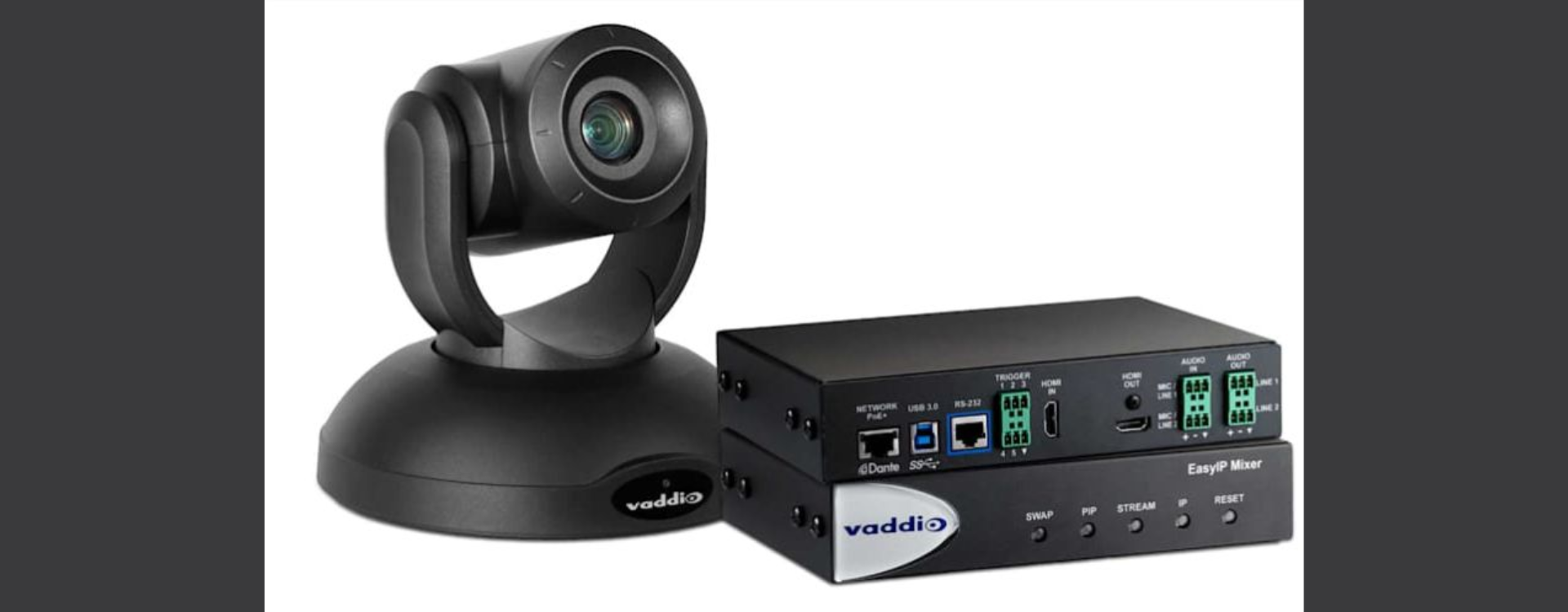
Vaddio’s RoboSHOT PTZ cameras and EasyIP AV-over-IP systems were built for exactly this environment. Rather than requiring proprietary cabling infrastructure, EasyIP transmits video and control signals over standard network switches dramatically reducing installation complexity in buildings that weren’t originally designed for broadcast-grade AV. For campuses upgrading existing spaces, this is a meaningful difference: less conduit, fewer specialized components, and IT infrastructure that already exists.
Collaboration Spaces That Actually Get Used
Beyond the traditional classroom, universities have invested heavily in collaboration spaces: group study rooms, design studios, maker spaces, and departmental meeting rooms. These spaces often get outfitted with AV as an afterthought: a display on a wall, a webcam on a laptop, a Bluetooth speaker that someone brought from home. In some instances, the technology gets avoided because it’s unreliable, and the space underperforms its potential.
Spaces that work share a few things in common. The display mounting is stable and adjustable. The audio is tuned for the room, not just plugged in. The connectivity is flexible enough to accommodate different devices and workflows. And the whole system is easy enough to use that faculty and students don’t need a tutorial before every session.
Chief’s display mounts and floor support solutions address a challenge common in campus renovation projects: spaces where wall or ceiling anchoring isn’t practical, historic buildings, leased facilities, or rooms subject to frequent reconfiguration. The Forum™ Floor Support Mount gives integrators a stable, professional-grade solution without structural modification.
For connectivity, PureLink's USB-C and HDMI solutions handle the signal path between devices and displays a deceptively important detail. In environments where students bring a mix of MacBooks, Windows laptops, Chromebooks, and tablets, end-to-end connectivity solutions that accommodate USB-C, HDMI, and legacy inputs prevent the all-too-familiar “my laptop doesn’t connect to the screen” friction that derails sessions before they start.
Procurement That Works for Higher Ed
Higher education procurement operates differently than commercial environments. State universities often work through cooperative purchasing agreements. Private institutions may require TAA-compliant products for certain government-funded programs. And most campuses are evaluating technology investments on a 10-to-15-year horizon, not a 3-year refresh cycle.
Vaddio’s TAA-compliant camera and conferencing systems are designed specifically to meet these requirements, removing a common barrier in government-funded education deployments. Combined with Legrand | AV’s portfolio-wide approach where mounting, cabling, networking, rack infrastructure, and cameras all come from brands built to work together, the procurement and integration process becomes more straightforward for both specifiers and the institutions they serve.
For AV integrators focused on the higher education vertical, this matters. A single-source portfolio approach reduces coordination overhead, simplifies warranty and support conversations, and gives institutions confidence that the system was designed as a system not assembled from unrelated components.
What the Modern Campus Actually Needs from AV
The evolution of higher education AV isn’t driven by technology for its own sake. It’s driven by what universities are trying to accomplish: better learning outcomes, more flexible use of campus space, lower operational burden on IT staff, and infrastructure that can adapt as teaching models continue to change. The technology is there. The question for integrators and campus decision-makers is whether the AV infrastructure in their buildings is keeping pace with what’s expected of those spaces and what it will take to close the gap.
Related posts
 Corporate presentations: leave everything to chance or rely on the right devices?